On Jan. 23, 1943, my uncle, Frank Ebner Gartz, (photo in uniform, above) reported to the draft board in Chicago to start his training for WWII. So began the correspondence between him and family & friends, comprising almost 300 letters going both ways. I’m posting many of these World War II letters, each on or near the 70th anniversary of its writing. To start with his induction, click HERE.


This blog began in Nov., 2010, when I posted a century-old love note from Josef Gärtz, my paternal grandfather, to Lisi (Elisabetha) Ebner, my paternal grandmother, and follows their bold decision to strike out for America.


My mom and dad were writers too, recording their lives in diaries and letters from the 1920s-the 1990s. Historical, sweet, joyful, and sad, all that life promises-- and takes away--are recorded here as it happened. It's an ongoing saga of the 20th century. To start at the very beginning, please click HERE.

Showing posts with label First World War. Show all posts

Tuesday, May 22, 2012

An odd fellow-missing World War I

World War I trench warfare
photo credit: www.anunews.net/blog
Last week’s photos pictured Josef and Lisi Gartz, with their two young sons, Friedrich and Wilhelm happy and healthy in Chicago about early 1916 (see below) and again in the summer of 1918. (See Family and Dead Dog).


These family photos were taken at the same time that Europe was engulfed in the nightmare of World War I, and most young men of Josef's age (25 in 1914)  would have been covered in lice, crouching and rotting in some trench, being blown up or blowing up other young men. 


My grandmother’s brother, Samuel, was one of those young men (See The Fallen-Part I).
Gartz Family ~ 1915-1916
L-R Lisi, Will, Fred, Josef
Let’s jump back four-six years before these family photos were taken, 100 years ago, to the spring of 1912. Josef and Lisi had married five months earlier and were both working seven days a week, Josef for fourteen hours a day, Lisi for twelve hours a day. They were barely getting by, but they had jobs.


Military Draft Notice, Josef Gartz
Austro-Hungary
Josef most certainly could have been among the dead had he stayed in Siebenbürgen (Transylvania). (See Drafted 100 Years Ago, where Josef's draft notice is translated to English).


But the first year after Lisi and Josef had married in Chicago, my grandmother’s former employer, Mrs. Jickeli, saw only youthful indiscretion in their decision to emigrate to America. Two months after Lisi and Josef married in Chicago on October 13, 1911, Mrs. Jickeli had written Lisi Ebner a letter expressing her dismay at Lisi's hasty departure to join her love, Josef Gärtz. She had chastised them both for their impetuous behavior and a host of issues, even declaring their marriage wouldn't be  considered valid in their homeland Siebenbürgen (because it hadn't been announced in the church).

She reiterated her concerns in a second letter, three months later, in what today we might say was “beating a dead horse," even if a stick of a slightly different length!

Merchant's wife, Berta Jickeli
born Henriette Albertine Krasser
March 15, 1912 

My Dear Lisi, 

Are you satisfied with your home (apartment)? Have you been employed long and how does Gärtz like the cooking spoon? [Josef was working in a restaurant when Lisi arrived]. That you live in peace makes me happy. I have certainly never doubted that Gärtz seems like a good man (Mensch). I have always considered him to be a good and respectable/honest/decent man, but a bit of an odd fellow.
 
But you also know that I am too old and have seen too much of life to scream “Hurrah!” A happy marriage is very rare in life and to be sure, even more rare because no one holds his fate strictly in one’s own hands and no one knows what tomorrow brings. Besides that, marriage seems different after 10-20 years than in the first year. That you will experience, just as everyone has. For you and Gärtz it’s just that you went into your marriage so fast and with such impatience. 
You will have to go through double the work and sacrifice and homesickness than you would have endured if you had waited one more year. Even our Lord God cannot reverse your fate. First Gärtz will have to comply with his military duty if nothing changes. Without you coming here, for the time, then the second thing that has to be is that your marriage must also be declared binding here. This is the only way a later happiness can bloom.

Mrs. Jickeli ends her letter with a few paragraphs of local news and heartfelt wishes, for after all, she was like a second mother to Lisi, and sincerely worried for her. 

And now, dear Lisi, I wish you both very well, and don't grow tired before you again have a strong foundation under your feet. We all greet you both from our hearts, and I remain for all time––Your old mother
Berta Jickeli


Berta Jickeli was right in one regard: people certainly don't have complete control over their fates, as all those who've been caught in war know so well. Yet Josef had influenced his fate, and the fate of his family, through his determination to get to America. The letters make it clear that friends and relatives back in Siebenbürgen/Transylvania expected he and Lisi would return. They didn't know Josef very well.

So when another serious problem emerged back in Transylvania after Josef left for America, his swift decision to leave his countryland again appeared to those back home to have been foolhardy. Apparently some local person had taken advantage of Josef’s departure, perhaps in cahoots with a local official, and co-opted from Josef his home and land. Both Lisi's father and Mrs. Jickeli weighed in on what had happened. Coming up next time at Family Archaeologist.

Tuesday, May 24, 2011

The Fallen - Part III

Travel Tuesday - Monument to the dead

Sam Ebner, Lisi's brother, died in the Battle of Galicia, one of the earliest battles in WWI. (See previous two posts: The Fallen-Part I and The Fallen-Part II). I wrote about my brothers and my 2007 visit to my grandmother’s (Lisi's) church courtyard in her hometown of Grosspold, where we discovered this monument inscribed with “Our Fallen Heroes.” Lisi's brother’s name, Samuel Ebner, was carved near the top.

But it wasn’t until I was able to decipher several letters from Lisi’s father (also Samuel) back home in Grosspold, that I realized Lisi’s direct connection to and partial responsibility for this memorial honoring her brother and other fallen soldiers of "The Great War," as it was known.

Here are two letters Samuel Ebner, the father, wrote to Lisi and Josef. The first is undated, but the content and date on the second make it pretty clear that both are from 1936.

Dear Children,

I must ask you for 100 Lei by March. At that time, a memorial for the fallen soldiers [of World War I] will be erected in the church courtyard and on this monument, the names of the dead will be written in gold letters. So I want to make this little request for 100 Lei* to be given for Sam. 

May 2, 1936

Dear Lisi,

I’m late writing because of...the memorial to our heroes who were laid to rest in foreign ground. The Memorial stands in the Church courtyard. I paid with the money from you, and your name was inscribed.

But my grandparents had sent more than just the 100 Lei* for the monument -- ten times more, in fact. The remainder of the letter shows just how much Lisi was helping her extended family during desperate times in 1936 Romania.

Dear Children, 
I received the 1000 Lei, and I send you my deepest thanks for it. I have often said already that we are so lucky to have you. Other people say how nice it is when the children think about their parents.
Best thanks again, you Dear Ones, for the money. We have paid the taxes for 1936 and bought pigs for next year.

(*Lei has been the currency of Romania until recently. I don’t know what the exchange rate in 1936 would have been, but I do know it was in the depths of the Great Depression. Not only were my grandparents trying to keep afloat in a dismal economy, they were financing a memorial and family 5,000 miles away)

Although separated by thousands of miles and away from her home town for twenty-five years, Lisi maintained strong ties to her homeland. One hundred years after she and Josef emigrated from Siebenbürgen/Transylvania, we can still see today the visible impact they made on a land their hearts had never left behind.


I look forward to your hearing from you. Please click on the word "comments," centered, below this post and leave me a message.

Tuesday, May 17, 2011

The Fallen - Part II

Travel Tuesday

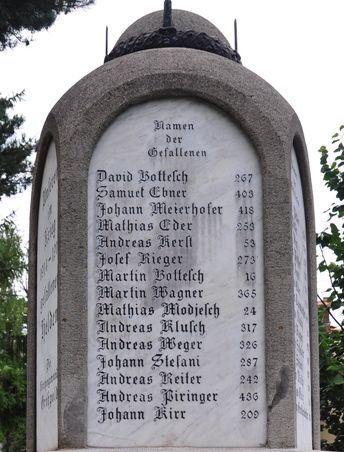
"Names of the Fallen"
Samuel Ebner-2nd from top

Father and Son, both Samuel Ebner
~ 1902-05.  My grandmother, Lisi's,
brother and father.
In the first post in this three-part series about Samuel Ebner,  my grandmother's younger brother, I explained how my two brothers and I discovered this monument to the fallen soldiers in World Wars I and II in the courtyard of my grandmother, Lisi's, home church in Grosspold, Romania. Samuel's name was listed near the top of the World War I "fallen." (See The Fallen-Part I).

We didn't know much about young Samuel (also my great-grandfather's name), but this photograph, at left, always hung in a prominent place in my grandparents' home and now hangs  as part of a 100-photo family history wall extending up the wall along my front stairway.  It's the two Samuels: father and son.   Hand-colored with pastels, the photo was made about 1902-05.

Once I was able to decipher some of the missives my grandmother had saved, I came across a very special one-- this postcard from her brother, Sam, addressed to his father, dated August 19, 1914. Samuel (who must have been nicknamed “Kaspar,” perhaps to avoid confusion with his dad) writes only the briefest of messages:

Dear Parents,

"Dear Parents" The final words received from
Sam Ebner (Jr.) written August 19, 1914
I share with you that we are now in Galicia. Most beautiful greeting to all. Farewell.

Kaspar Ebner

On the right side he’d added: Don’t answer [this letter].

Perhaps he didn't know where he'd be. Perhaps he knew what a terrible battle he was about to enter. The day before young Samuel wrote this card, on August 18, 1914, the Russians had invaded Galicia from the east, in one of the earliest battles of World War I. The Russian army would eventually devastate the Austro-Hungarian Army in which Samuel was soldier. He died during the Battle of Galicia on August 26, 1914, just eight days after penning his last words.

Grosspold Church Family Book entry for  Samuel Ebner (Jr.) the youngest
son of Samuel Ebner and his first wife, Elisabetha Eder/Ebner
 Birth column: 6/16/1893.  Death column: 8/26/1914


His birth and death dates (latter barely legible) were entered into the Family Book from the Evangelische Lutheran church and show he was born June 16, 1893. He was twenty-one when he died.

At some point, my grandmother’s half-brother, Hans, sent her the above postcard, adding this heart-felt note on the address side:

Dear Sister,

I’m sending you here the most valuable thing I’ve ever had--because it is the last writing from our dear brother, Sam--in the hope that you will treasure it as I have.
Hans

The fact that I still have this postcard, almost 100 years later, is testimony to the care my grandmother took with this precious last message.

But not only did she save her brother’s memory in this modest missive, she helped make possible the impressive memorial whereon were inscribed her brother’s and his fellow fallen comrades' names.  More on how I discovered this connection in the third part of this series on Samuel Ebner, "the younger." Look for "The Fallen - Part III" next Travel Tuesday.


I look forward to your hearing from you. Please click on the word "comments," centered, below this post and leave me a message.


Tuesday, May 10, 2011

The Fallen - Part I

"Names of the Fallen"  #403 "Samuel Ebner"
Travel Tuesday 


Many of us family history buffs have relatives/ancestors who fought in World War I and/or II, and if they died in those wars, it’s likely  we might find their names on a memorial in their home town, on a  plaque in a church, or eulogized in a newspaper article.

When we visited Grosspold in Transylvania (prior to 1914, part of the Austro-Hungarian Empire) to find my great-grandfather’s house, we weren’t looking for a memorial, but we unexpectedly found one.

In the courtyard of the church my grandmother had attended, we saw this memorial. The following is inscribed on one side (photo) “Our fallen Heroes in the War 1914-1918, The Church Community of Grosspold”

"Names of the Fallen"
Samuel Ebner #402, 2nd from top
On the other three sides are listed “Names of the Fallen,” including my grandmother’s brother, Samuel Ebner, born 1894. His name is the second from the top (left photo. Close-up at top of this post).

But it wasn’t until several of the letters in my collection were deciphered from the old German script that I made some astounding connections, both about this monument as well as the last words the family ever heard from young Samuel. Watch for "His Final Words," coming up.

I look forward to your hearing from you. Please click on the word "comments," centered, below this post and leave me a message.


Tuesday, May 3, 2011

The Fallen -- coming in three parts


The letters were hidden for decades, but when they were brought to light, their indecipherable handwriting unraveled, and the readable German words translated into English, they revealed unknown secrets about my family's relation to this monument and a relative whose name appears right near the top.

PHOTO AT LEFT:
War Memorial--Grosspold, Romania--my grandmother, Lisi Ebner/Gartz's hometown when it was still part of Austro-Hungary.


Part I
What this war memorial revealed to my siblings and me on our 2007 visit to Grosspold, my grandmother's hometown in Romania.

Part II
The last words of one of Grosspold's  "Fallen Heroes."

Part III:
Lisi and Josef's role in creating this memorial--from 5,000 miles distant.

PHOTO AT RIGHT:
War Memorial, Grosspold Evangelische Lutheran Church, Romania
(Another view of same memorial shown above)

Top section reads: To Our Fallen Heroes in the War 1914-1918

Bottom section reads: To Our Fallen in the Second World War and to Our Dead in Russian