On Jan. 23, 1943, my uncle, Frank Ebner Gartz, (photo in uniform, above) reported to the draft board in Chicago to start his training for WWII. So began the correspondence between him and family & friends, comprising almost 300 letters going both ways. I’m posting many of these World War II letters, each on or near the 70th anniversary of its writing. To start with his induction, click HERE.


This blog began in Nov., 2010, when I posted a century-old love note from Josef Gärtz, my paternal grandfather, to Lisi (Elisabetha) Ebner, my paternal grandmother, and follows their bold decision to strike out for America.


My mom and dad were writers too, recording their lives in diaries and letters from the 1920s-the 1990s. Historical, sweet, joyful, and sad, all that life promises-- and takes away--are recorded here as it happened. It's an ongoing saga of the 20th century. To start at the very beginning, please click HERE.

Showing posts with label ship manifests. Show all posts

Tuesday, March 27, 2012

Paris Dress Design in Chicago

S.S. Geroge Washington
photo credit: www.norwayheritage.co

Louise Woschkeruscha, my maternal grandmother, boarded the S.S. George Washington on March 8, 1913, a month after leaving three years of paid apprenticeship and another three years as journey-woman in the Viennese clothing salon of master dressmaker, Elise Vogel. 


Hans's "Passenger Record," created by Ellis Island's
American Family Immigration History Center
Louise arrived in New York Harbor nine days later. She planned to meet  up with her brother, Hans, who had left the year before on the very same ship, entering the United States on May 23, 1912, a century ago. Leaving his abusive and hated father behind, Hans arrived with the skills of a wagon maker and carpenter, giving him an edge over the mostly unskilled immigrants pouring into the country at the same time. I assume Louise moved in with her brother, but I can't say for certain. 

Louise's "Passenger Record," created by Ellis Island's
American Family Immigration History Center
A few months later, in October of 1913, she wrote a letter to Frau Vogel about her new life, starting with her voyage across the Atlantic. The contents make it clear they had corresponded before, but unlike my paternal grandmother who saved every letter, this is one of just a couple of  missives I have from or to Louise (and why I have a letter Louise wrote, is a puzzle). Here are excerpts from that letter.

October 1, 1913

Dear Frau Vogel, 

Louise's 10/1/1913 letter to Frau Vogel
I have received your letter with thanks and joy, I was really very pleased that you wrote yourself because I know how hard writing is for you, and yet you were the first one who has [written me].
Now I want to tell you a little about my journey and how I’m doing.
When I left home, I didn’t realize what a huge trip I had ahead of me.


I had absolutely no fear when I saw the enormous water, and did not become sick at all. You cannot really become fearful. First there is always entertainment on the ship: evening concerts, and by day there are varied games, like one might play at a party. Very nice people are there so that I was never scared.

After her arrival, Louise was cheerful and optimistic about her prospects.

Louise and brother, Hans Woschkeruscha 
(later John Miller) probably in Chicago
I can hardly believe I’m in America! [After arriving in New York], we had to travel two days and two nights in 2nd class on the fast train [to Chicago]. Everyone spoke only English and I couldn’t understand a word. That struck me as so funny, I laughed and laughed. I really had fun on the trip so that I hardly had any homesickness. 

Louise rested up for one week before placing an ad in the newspaper, marketing her skills as a dressmaker. She continued her letter, describing the Parisian styles of fine clothing she is creating. It sounds like a very exclusive dress-making shop.

I immediately got a job, where I am now. We make only silk and lace dresses, and some of the dresses cost $100! We make them just like the crazy fashions in Paris chic. In America, people wear a lot of red.

Louise Woschkeruscha-date uncertain
The vests and the blouses are heavily gathered at the top and are worn under the hips. The widths are 28-30 by American measure, which is about 80-90cm in our measure. 

I still don't know English because I work with Germans and only German is spoken. From October 6 on, I'll go to evening school....When I know some English, I would like to earn a little more.

Evenings I go to the cinema and Sunday afternoons to the German concert. You write me, dear Frau Vogel, whether I'm afraid. Still never. I would only like to have my parents here. You'd really have to search throughout America to find such a woman as my mother!

I end my writing and hope that it finds you in the best of health. Heartfelt greetings from your former, thankful worker, Luisa. 

Louise undoubtedly met many young German-speaking men at the concerts she attended, perhaps even at the cinema, but it would be several years before she found a man whose affections she felt she could trust, given her smallpox-scarred face. Next week we'll meet that man––John Koroschetz, also from Austria, who had his own tale of physical––and emotional loss.

P.S. If you missed the interview with me that gives the backstory on this blog go to this link Digging Up Family History or to the previous post, to learn more about the interviewer, Joan Brunwasser. 

Tuesday, August 2, 2011

An Alien Made Manifest


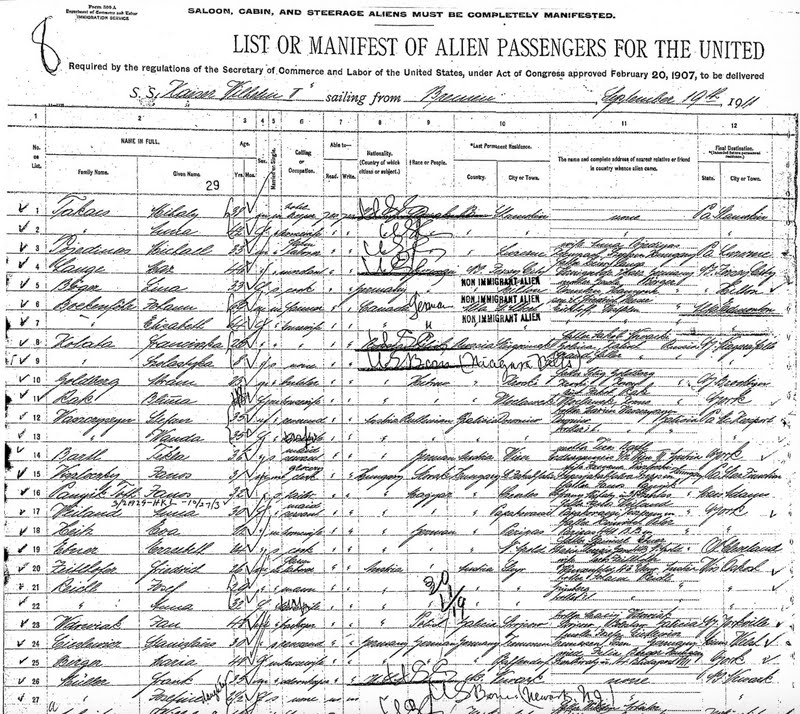
Every ship entering the port of New York was required to provide customs officers with comprehensive details of its cargo, passengers, and crew. The "List or Manifest of Alien Passengers" (left) is a snapshot of a single moment--a century the  the past. It captures salient details of the 800 or so people who arrived on the same ship,
just as they were embarking on their wholly unknown future in a foreign land--the U.S.A.

The manifest allows us to look back upon our ancestors through the eyes of one of the first officials to welcome (and scrutinize) them as they stood before the officer, undoubtedly with  heart in throat, wondering if anything they said might provide an excuse to send them back whence they came.

Whoever looked at my grandmother, Lisi, when she arrived on the evening of September 26th, 1911, began filling in the twenty-nine columns on line 19 of the manifest with the details that the U.S. wanted to know about this "alien" prior to her entry into this country.

Line 19 of manifest for the steamer, Kaiser Wilhelm II
Columns 1and  2 -- her full name: Ebner, Erzsebeth (see detail, above)

Never mind what her real name was. They took the Hungarian equivalent, Erzsebeth, from her passport/Dienstbuch [for details of this dual-purpose document, see 6/14 post, When a Resume Worked as a Passport)

The mistaken transcription

Years later, when all this information was transcribed into a searchable database, her name was mistakenly copied as “Ebnor” with an “o” and Erzebeth was miscopied as “Erssebeth,” making my search just a tad more difficult. But because of the detailed information Lisi had written on the postcard of her ship (see last post), I found it. The U.S. wanted further bureaucratic information:

Column                  Question             Lisi's answers
3                                Age                         24
4                             Gender                        F
5                             Married/single             Single
6                             occupation                   Cook
7                             Able to read/write        yes/yes
8                            Nationality                   Hungary
9                            Race/people                 German
10                        Last Permanent
                              Residence                   Hungary, N[agy] Apold [Hungarian for Grosspold]
11                          Nearest relative
                            In home country           Samuel Ebner [father]
12                        Final Destination           Cleveland, Ohio
Compose
Aha! Question #12, the last question on the first page of the two-page manifest, is how I discovered that Lisi didn’t go directly to Chicago to meet my grandfather. Instead her first stop was Cleveland, where her stepsister, Maria Wagner,  lived. I hadn’t known this before.

The questions continued on the second page, allowing us to stand in the interrogator’s place, and imagine how Lisi appeared to him/her:

Height:                         5’ 4”
Hair:                             black
Eyes:                            grey [I recall deep brown eyes!]
Complexion:                fair [not really]
Marks of identification:  none

Is she’s a polygamist? No.
An anarchist?             No.

(Who would answer “yes” to these two questions?!

Condition of her health, mental and physical: good

Deformed or crippled?  No.
In possession of at least $50 and if not, how much? $40

Ticket to final destination? Yes
Who paid for passage?       Self
Ever in U.S. before?           No

Manifest showing (left) Lisi arrived with $40; Right: the name of
address of her destination: Rudolf Wagner, 4287 St. Clair Avenue,
Cleveland Oh
Going to relative or friend? If so [give] complete address:

Rudolf Wagner [her stepsister’s husband] 4287 St. Clair Avenue, Cleveland, Ohio.


I had seen that name before, and this piece of unknown information on the manifest was a revelation that connected Lisi's arrival to an incident forty years later.

A family of documentarians brings life full circle


I had never met the Wagner family--nor do I recall hearing about them--until I read my father's 1950 diary. During one of his many business trips out of state, he traveled to Ohio and made a side excursion to visit the Wagner family in Cleveland. By 1950 they had grown sons, owned a restaurant where the sons and father switched off to work night and day, and had many American luxuries. Another immigrant family that had fulfilled the American dream. Details to come.

Meantime, Lisi successfully passed inspection, both health and moral (no polygamy or anarchism!). Josef will have to wait a few more weeks to see his darling, but she let him know she had arrived safely.
Coming up: the postcard of New York Lisi sent to him and how a seemingly unimportant business card turned out to be a key clue as to how they connected in Chicago.

Friday, March 4, 2011

Mystery of Missing Manifest: Solved

First page of Josef Gärtz's diary
on right; lower left he wrote
"Kronprinz Wilhelm" see detail
Even handwritten documentation from our ancestors can lead us astray as we search for the details of their pasts. In my case, it was my grandfather’s diary, a primary document, in which he had written the name of a ship on the first page. At the bottom, under a list of three “Kaiser ships” he had handwritten, “Kronprinz Wilhelm.”
This seemed a pretty good clue that this was the ship that brought him to America, as he had not noted a different ship's name anywhere else in his diary. However, as I had originally posted, I could not find his name on the manifest (list of passengers) for the Kronprinz Wilhelm, which had arrived on January 12, 1911, a logical arrival date for a ship that had left, according to his diary, on December 31, 1910. I also tried searching any ship around that time, thinking perhaps we had the wrong ship. I tried entering just the “sounds like” for his name, but included his birthdate as 1889, give or take a few years. No luck.

Friedrich der Grosse-Josef Gärtz's
name found on this ship's manifest.
Recently, through the German contact that helped me decipher my grandfather's diary from the old “Gotisch” German, I was put in touch with Monika, a woman whose specialty is researching immigrants from the Siebenbürgen area to North America. She has looked for hundreds of names on ships‘ manifests, and knew the pitfalls. She said she also prefers the Steven Morse site (vs. the Ellis Island site) to search for ship manifests.

When she noticed I couldn’t find my grandfather’s manifest, she searched and found it! As she said, “The problem is that the transcribers [of the original handwritten documents] came up with the most outlandish spellings in the indices at Ellis Island (and at any of the ports). It took more imagination to come up with what they did than to read what was in front of them.” Of course we are searching what the transcribers for the data base thought they read--not what was actually written.

Manifest for "Friedrich der Grosse, sailing from Bremen"
Line #8 Gärtz, Josef  (misspelled Görtz by transcriber)
In my grandfather’s case a couple of errors. First, his name was transcribed as “Gortz,” a misreading of the name that is understandable--it could be “o” or “a” as handwritten.
But the real goof-up came with his age. The manifest had originally noted his was “29,” but then sloppily corrected his age, rightly, to “21.” The transcriber missed the confusing correction and miswrote his age as eight years older than he was. I didn’t search for that wide of an age difference.

detail #8: Gärtz -- Josef -- age 21 (mis-recorded "29") carpenter, German, from Kistorony (Hungarian for Neppendorf)
Looking at the manifest for the ship, Friedrich der Grosse, which arrived in New York on January 11, 1911,  I’m able to find my grandfather’s name on line #8. Why this ship did not come up in my original search for any name sounds like “Gartz” (and even when I searched for "Gortz" the program didn't find him) is not clear. What is clear is that #8 on this manifest is my grandfather, Josef Gärtz: Age: 21 (corrected); occupation: carpenter; Nationality “German” Last permanent residence: “Kistorony” (the Hungarian name for Neppendorf); destination: Cleveland, including the address there of the friend who was to meet him, Gottfried Nuss.

I’m very grateful to Monika for her expertise and help in solving the mystery of the missing manifest, and to know now which ship Josef travelled on. I’ve corrected my previous posts to reflect the accurate information.