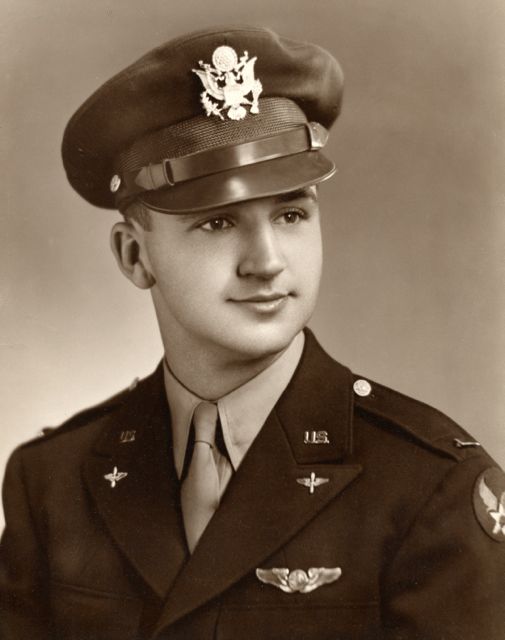
On Jan. 23, 1943, my uncle, Frank Ebner Gartz, (photo in uniform, above) reported to the draft board in Chicago to start his training for WWII. So began the correspondence between him and family & friends, comprising almost 300 letters going both ways. I’m posting many of these World War II letters, each on or near the 70th anniversary of its writing. To start with his induction, click HERE.


This blog began in Nov., 2010, when I posted a century-old love note from Josef Gärtz, my paternal grandfather, to Lisi (Elisabetha) Ebner, my paternal grandmother, and follows their bold decision to strike out for America.


My mom and dad were writers too, recording their lives in diaries and letters from the 1920s-the 1990s. Historical, sweet, joyful, and sad, all that life promises-- and takes away--are recorded here as it happened. It's an ongoing saga of the 20th century. To start at the very beginning, please click HERE.

Thursday, January 31, 2013

"Unlimited opportunities..."

Will Gartz, Harlem Airport, 1943-1944
Writing Ebner became focal point of Gartz family life. Here's a letter from the oldest Gartz brother, Will. Born in 1913, he was eleven years older than Ebner.  Age 29 when Ebner was drafted, Will was probably too old for the draft  himself, but he did his part, by becoming a pilot in the Civil Air Patrol.

The previous November, 1942,  the month my parents married, Congress lowered the draft age to eighteen, just in time to require Ebner, who was born May 14, 1924, to enlist. As you'll see, Will was a serious fellow. The eldest, of three boys, he was the "good boy," always following the rules, and offering advice to his younger brothers.

I've shortened the transcription of Will's 1/31/43 letter just a little, to eliminate uninteresting or confusing sentences, but you can read it in its entirely at the end.

Note: The Von Arx family, mentioned in Will's letter, included another Frank, who was my uncle's best friend. They called each other's mothers "Mom." A letter from Frank Von Arx, also in the military, is coming up soon, a window into these young men's experiences and their adorable senses of humor.

Sunday Jan, 31, [1943]
7 p.m.


Hello Frank:
Just arrived home from the field after quite a day of weather changes that started with a fog which partly cleared, then closed in, then a rain with wind from the southeast which gradually changed to snow and wind from the northwest. The transformation was a typical “cold front” leaving all the streets covered with ice.


Enough of this now and greetings old boy. How are you and how do the regulated hours agree with you? So you’re slated for radio work. Well, it’s a great field with unlimited opportunities, so apply yourself and go the limit. Just what phase are you in anyway?
The Von Arx’s have been asking for you constantly and Mrs. Nielson has asked for your address so she can write you. Things sure are quiet around here and we all miss you. Until our next, hasta la vista.


Will


P.S.
Have you still possession of your watch? We have been told that watches disappear quickly in the service, especially in your neighborhood....Eyes open.


Wednesday, January 30, 2013

Here to help.

Ebner and his Mom,
Lisi Gartz, 1/16/1943
My grandmother's letters to her son were written in a foreign language––English. 

Lisi Gartz's schooling back in Austro-Hungary, before it became Romania after World War I, only went as far as the fourth grade, so even in her native tongue, spelling and grammar had never been mastered. 

At the time her youngest son was drafted on January 23, 1943, she had been writing to her relatives back home for more than thirty years. Now, for the first time, she had to write in English. I know that she kept a German English dictionary by her side, struggling to put into words what was in her heart and mind. She became Ebner's most loyal correspondent.

Her letters are written with a German accent, as she tries to work out  the phonetic spelling of English words she knows, but probably never saw in print. I've corrected some of the spelling and grammar in this and all future transcriptions, only as much as needed to make the letter understandable, but I've left much of her syntax as written to be as true to the original as possible. 

Until I read her letters, I had no idea how much my grandmother's religion meant to her. In virtually every letter, she wrote of her prayers to God and her trust in Him to protect and guide her youngest son. 

The family usually addressed the "baby" of the family by his middle name, Ebner (ABE-ner), my grandmother's maiden name. This is her first letter to Ebner, written a week after he left for training. 

Notes: 
1) At the time of my uncle's military induction, my grandparents had been making their living for more than 20 years  as janitors for several large apartment buildings on Chicago's West Side. They cared for up to sixty-five apartments. It was hard, non-stop, physical work: all repairs, window washing, cleaning vestibules, shoveling coal and snow in the winter, repeatedly climbing multiple flights of stairs to take down the trash. That's just a tiny sampling. They had lived frugally, saving $200/month of their $250 income, and supporting the whole family of five on the remaining $50. Their savings allowed them to buy at least one six-flat, by this time, mentioned in the letter.

2) The "green light" she mentions in this letter were two small table lamps with green, beaded shades,  flanking Ebner's high school picture.  My grandmother's original letter appears below this shortened transcription.

Chicago, Il 1-30-43

My Dear Ebner,

You had to wait five days befor I anserte your letter, but you know how it is in our work some days––running the whole day up and down especially in morning time.

The 27 Sep I sent you sweatshirt and some banana. Have you received everyting? Please tell me next time.

We are all happy that you have a goot room mate from Minnesota you picked yourself.
That is very goot. We are all proud of you that you get the best road in life.
Even [if] you got it hard, trust in God all the time and always you [will] get the best for you. Even your wishes will come true in time. Did you gain or lose weight? I hope you are healthy and happy too.

I put 2 dollars in for you till you get your pay. We got [hit] so hard with the income tax. Both Pa and me have to pay from our allowance of man and wife $1300.00 for a year.  From that we have to take out $200.00 for the 6 flat one payment and then all of our life insurance.

So, my Dear, I have to learn now how to do the figuring real goot. But I will be always ready for you at all times, whatever comes up. I am here to help.

God be with you always. All the time I am praying, standing by the green light.

Lots of love and kisses,

Your Mom
Love from Dad and Will


Sunday, January 27, 2013

A WWII Draftee's First Day.

Arial photo of Camp Grant, probably WWI
Public domain
Frank Ebner Gartz, my uncle, was drafted into World War II on January 23, 1943 (see previous post: A World War II Draftee- 70 Years Ago)

The next day he wrote from his new home at Camp Grant, near Rockford, Illinois. Until I found the letter below, I hadn't know where he had started his training. Here's how the first day in training was reported by a new inductee on his first day in camp. 
Note: I corrected spelling and added punctuation to make reading easier. Original below transcription.

1-24-43

Dear Mom,


I just came home from church. It's 9:30 and our barrack woke up at 6:45 this morning, one hour later than usual. We made our bunk, washed, and ate. now we have the day to our selves. Tomorrow (Monday) we get our uniforms and our classification. We arrived at 8:05 P.M. last night. OUr train was very slow. A normal trip of two hours took us twice the time, four hours and fifteen minutes. I'm going to read the paper now. There's nothing else to do. I might get in a card game that is just starting. Hope everyone at home is well. I got the upper bunk and it's very warm near the ceiling. Take it easy and I'll write again soon. 


Your loving son,

Frank

P.S. You can't write me here because Camp Grant hasn't a receiving station for mail.


Wednesday, January 23, 2013

A World War II Draftee––70 Years ago

Blitzbuggy at the Draft Office, Chicago, 1/23/1943
Seventy years ago today, my grandparents and newly married parents faced a foreboding task, one that was shared by just about everyone in America with a  young man of draft age in the family.

On January 23, 1943, they climbed into Dad's Model A Ford and drove the five blocks from their home down Chicago's Washington Boulevard to the draft office, where my Dad's ten-year younger brother, Frank Ebner Gartz, would officially report to begin the training to become a navigator for the Army Air Corps in World War II.

Gartz Family, January 16, 1943 L-R top Fred (Dad), 
Will, Ebner. Seated: Lil (Mom), Josef, & Lisi Gartz
The photo to the right is the first "Gartz Family Photo" that includes my mother. Taken just two months after my parents married, and one week before Ebner was drafted, my guess is that my grandmother wanted a family picture with the "new Mrs. Gartz" as part of the family before her youngest son left for training. 

I know the dates of both  photos because each was labeled, but the car photo had more than a date. Coming upon it, I saw only an unremarkable old car parked on a snowy street, with no identifiable people. But it was on the back where I learned the critical event this photo documented.

Prior to finding the photo of the car, Blitzbuggy had only existed in family lore. My father had probably told us what vintage the dear little car was, but it hadn’t stuck in my memory. Dad’s notes not only identified the car--its year, model, and make--but also recorded the contribution Blitzbuggy had made to one of the pivotal events of the 20th Century -- and our family’s connection to it. 

Here are his exact words--in italics (my comments are in brackets. Parentheses are his):

January 23, 1943

Ebner’s drafting. Saying farewell. Grandma [Dad's mother] in Blitzbuggy (1929 Model A Ford). Lil [my mother] on right side. [Only the back of her coat and hair are visible.]

In front of the Draft board
4748 W. Washington Blvd. Chicago, Ill 

Frank Ebner, (ABE-ner) Gartz, born May 14, 1924, was  my grandparents’ youngest son. His middle name was taken from my grandmother, Lisi’s, maiden name, one you’ve read in numerous past posts.

The photo reveals a familiar Chicago winter scene: the snow is piled on the sidewalks, and greystone apartment buildings, typical of the city, form a backdrop. The entire atmosphere of the photo--its blurry focus, the gloomy, colorless weather, the faces of the two women in the photo hidden or indiscernible, the lone black auto on a strangely empty street--create a visual metaphor for the emotions of a family about to send its youngest off to war.

This date also started a flurry of letters back and forth between Ebner, as everyone in the family called Frank, and his family and friends. I hope to post excerpts of several of the letters, on or close to the day they were written. So keep tuned.

Note: parts of this post were published in February, 2011.

Sunday, November 11, 2012

Facing Death: A Veteran's Day Tribute

Lt. Frank Ebner Gartz DOB 1924

This Veteran's Day, I'm remembering two relatives who each served in one of the two world wars.

World War II
My dad's younger brother, Frank Ebner Gartz, was a navigator in the last year of  World War II. He trained stateside from January, 1943, through December, 1944. On Christmas day, 1944, he and crew of young men flew to Italy via North Africa to fly missions as members of the Second Bomb Group stationed at Amendola Air Base, near Foggia, Italy, on the Adriatic Coast. 

Frank Gartz and his crew. Frank standing 2nd from left.
Frank flew twenty-five missions. One of my  favorite quotes from his letters was advice he gave to  his bombardier, whose actual last name was Booms (did a name define his  destiny?). The bombardier and navigator sat in the half-spherical Plexiglas nose of the B-17, able to see clearly all the enemy flak zooming toward them. Frank wrote my grandfather after a particularly harrowing mission in March, 1945:

Today I flew my 10th mission, and it was the hottest thing I have seen so far. There was more and bigger flak. We bombed an oil refinery in North Eastern Vienna and those people don’t like us to drop our presents to them. 

B-17s flying in formation; photo taken by
Frank Ebner Gartz (see below for permission
to use photos from this blog).
Lt. Booms, my bombardier, had a rough time. He said that they threw everything they had at us including their kitchen sinks. Booms has to sit up in that Plexiglas nose where he can see all that stuff exploding around him. It sort of gets on his nerves. I was trying to explain to him that when your time comes it doesn’t matter where you are…your number is up, and that’s all there is to it.

Such was the fatalism of a twenty-one year old who faced death every time he navigated his crew of other equally-young men on their missions. 

World War I

Veteran's Day was originally called Armistice Day, to mark the date, November 11, 1918, when the armistice was signed that brought an end to World War I hostilities. On June 1, 1954, the name was changed to Veteran's Day, to honor American veterans of all wars. I'm also honoring the memory of my Great-Uncle. 

My grandmother's brother, Samuel Ebner, was also twenty-one when he was sent off to fight in the Battle of Galicia in August, 1914, one of the first battles of the the First World War, then called "The Great War." I have no photo of him, only this last postcard he wrote on August 19, 1914, just eight days before being killed. He wrote:

Dear Parents,

I share with you that we are now in Galicia. Most beautiful greetings to all. Farewell.

War Memorial to "The Fallen"
Grosspold, Romania
Photo by Ulrich Wien
Kaspar Ebner 
(apparently a nickname since his father was also named Samuel)

My grandfather, twenty-one when he came to America, missed fighting, and likely dying, in this awful war, as I wrote about in a previous post, An odd fellow.


To read more about Sam Ebner (Jr.)  and the memorial that stands in honor of him and his fellow soldiers from Grosspold, Romania, lost during that tragic war, see The Fallen-Part IThe Fallen-Part II, and The Fallen-Part III. Part III reprints the letter my grandmother kept, that reveals how she and my grandfather, 5000 miles distant from their homeland, helped make the memorial possible.

So today, I thank all of our men and women serving so far from home for their service, bravery, and commitment in our own tragic war. I wish them safely returned into their families' arms again.

To read my Chicago Tribune Perspective essay  about my grandmother's heartfelt letter to my Uncle Ebner, written on November 11, 1943, into which she  "poured all the mothering she could muster,"  go to this link: "Words, War, Worry"

Most of the content of his post was originally published in honor of Memorial Day, 2012.


Please, if you would like to use any of the photos on this 
blog, you must ask permission, credit the photographer, and provide a link back to this blog, Family Archaeologist.  

Thursday, November 8, 2012

Happy 70th Anniversary, Fred & Lil

Fred and Lillian Gartz, Nov. 8, 1942, outside church

Seventy years ago today, my Mom and Dad vowed to stick together in good times and bad, in sickness and in health. Those vows were tested across the decades, but despite life's pummelings, they stayed together to the end. This post was originally published last year on their 69th anniversary. I publish it again because seven decades deserves a shout out.


Their invitation tells us the wedding took place on a Sunday, and this article about the event, ("Miss Koroschetz Weds Fred Gartz At Bethel Church") published in the West Garfield Park local newspaper, The Garfieldian, includes wonderful sartorial details: 

"The bride wore a gown of egg-shell satin with a fingertip veil held in place with a seed pearl tiara. Her flowers were white chrysanthemums." The matron of honor wore a "gown of fuschia velveteen and net with a Juliet cap and carried pom poms." The bridesmaids' gowns "were of plum velveteen and net." Mom saved small samples of the fabric, labelled as to who wore which.

Mom planned the bridesmaid’s outfits to be practical. It was the war years, after all, and Mom wanted her bridesmaids to get use out of the outfits after the wedding. Remove the net over the skirts, and each had a beautiful velveteen suit. 

Of course, being a skilled executive secretary for the president of the Bayer Company, mom created a minute-by-minute run-down of the ceremony and reception, who had to be where at which time.

Speaking of the reception, what do you think that might have cost back in 1942? So glad you asked! Here's the receipt for the Central Plaza Hotel. (Click link to see postcard image).  This bill appears to include everything. I'm assuming the line item: "32 covers @ $1.50 each" refers to the cost per plate of dinner. If you have a different idea, weigh in. Cake for 32:  $12.50. Juke box: $10.00. The rest, including candles, tax, tip, ferns, and a case of ginger ale comes to a grand total of $72.60. I know my parents weren't tee-totalers, so they must have supplied the liquor separately.

Eva Coleman [who just passed away this past fall], a voice major and friend of Dad's from  church, sang "Because." Everything went without a hitch--except for one. Ken Eggen, Dad's best friend and one of the groomsmen, fainted dead away during the ceremony. Dad immortalized this memorable event in a loving poem he wrote to Mom for their tenth anniversary. Its cadence is reminiscent of "The Raven," written by Edgar Allen Poe about his lost love, Lenore.  I’ve included Dad's poem below, just as my dad would have presented it to Mom, handwritten on parchment, carefully laid out to keep each line straight and perfectly-spaced. (Just a little note: in stanza 4, "Blitzbuggy," refers to my dad's 1929 Model A Ford. "Blitz" means "lightning." To learn a little more about this automotive steed, and its role in World War II, see the post, Blitzbuggy––A Car with History.)

If you'd like to see how their courtship started and progressed, click on the post Falling in Love 70 Years Ago, and follow along with my mother's ecstatic diary entries week-to-week.
Please click below this post on the red word, "comments." Any ideas what your parents' or grandparents' weddings cost? It would be fun to compare notes.

Left to Right, Ken Eggen (who fainted during the ceremony) Frank
Ebner Gartz (17-year old brother to Dad), Lillian, Fred, Will Gartz (Dad's
29-year old brother). Seated: Arlyne Hennings, Myrtle Haling, Gertrude
Nowles, maid of honor.

Tuesday, September 18, 2012

A Millennium of Germans in Transylvania

This post was originally published on my blog on February 1, 2011

Evangelische (Lutheran) Kirche Neppendorf (near Sibiu)
Historically, the Gärtz family church

TRAVEL TUESDAY
Church as History

On the second day of our 2007 roots-finding trip in Romania, my brother, Bill, and I met up with Renate, church secretary of the Evangelische Kirche Neppendorf, (the Gärtz family church). Her impressive knowledge of the church's, Siebenbürgen, and Gärtz family history opened our eyes to the role Germans had played for nearly 1,000 years Transylvania.

Built in the 14th Century, the Evangelische Kirche was originally Catholic, but as the Reformation swept across Europe (Martin Luther's nailing the ninety-five theses to the church door at Wittenburg in 1517 launched the fight between Protestants and Catholics full force), the residents of Neppendorf, like most Siebenbürgen Germans, chose to become Lutherans.

Pastors of the Church from its
Catholic roots in 1330
That history is on display the moment one steps into the church. Posted at the entrance is this list of pastors (Pfarrer). The first began his tenure about 1330. Further down, it's noted that under Pastor Michael Binder, #13, (serving from 1536-1548), this church of ethnic Germans became protestant.

How the Germans came to Transylvania

How was it the Germans first came to Transylvania, eventually numbering as many as 800,000?  After centuries of invasions by various migrating peoples, Transylvania came under the rule of the  Hungarian crown in the 13th century. The Hungarian king at the time, King Geza II, persuaded Germans, primarily from Luxembourg and the Moselle region (near Alsace) to immigrate to Transylvania. He wanted them to defend the southeastern border of the kingdom from regular and brutal invasions by the Tartars. He also knew that the Germans' industrious nature, mining expertise, and farming know-how could help pump up the economy of his kingdom.

The Germans built cities and churches surrounded by thick walls, behind which locals fled to escape invaders. Hence the region’s German name, Siebenbürgen (Seven Fortresses seems the best translation). The area also became known as “Saxon Land” for its large German population, and is listed so today in tourist guides.

But Renate had more for us than the broad history of the Germans in Transylvania. She presented us with a two-page document of our family's history in the town of Neppendorf, researched by a previous pastor. It was filled with insights into 18th-19th Century Transylvanian life as filtered through the Gärtz family experience. Next up on "Travel Tuesday.”